I arrived to Taiwan safe and sound. Of course, there was some interesting things that happened along the way. I flew from Incheon to Qingdao at 8am. When I connected in Qingdao, I was put in a "time out" of sorts because I didn't have a Chinese visa. After I convinced the two officials as they examined my itinerary and passport that I will be leaving Qingdao in two hours and that I will not be leaving the airport, they allowed me to continue on my way. I never seem to have a dull moment at airports, even when I am prepared with everything I need, there always seems to be some misunderstanding or bump in the road. Oh well
I arrived in Taipei around 4pm Saturday. I waited at the airport for one of my fellow volunteers to arrive as well as two of the long term missionaries. While I waited in the "meeting place" area of the airport, I was able to watch the home run derby of the Taiwanese baseball league. It was very dynamic as the winner was able to hit twelve home runs. My fellow volunteer, Cana, arrived around 7:30. She is a Law student from Sheboygan (she was a student at my uncle's high school, it is a small Synod!) The two missionaries were late to arrive because one of them learned that his luggage was still in Chicago. Once they gave the airport information on where to send the luggage, we headed to the bus terminal.
The two missionaries, Kevin and Matthew, have taught in Taiwan for about seven years. They told me and Cana a lot about the school and Taiwan in general on our three hour bus ride to Chiayi.
When we arrived, we met the other two missionaries that are here, Amy and Ben, as well as the other volunteer, Ryan. We are staying on the campus of Concordia Middle School in the teacher dormitory. It has several rooms as well as a kitchen and a common room.
The next morning, we went to the Lutheran church in town for the service. It's quite interesting where God puts you at His determined times. A year ago, I was in Brochet attending the evening prayer Mass in Cree. A year later, I am in Taiwan worshiping with Taiwanese brothers and sisters in Mandarin. We were fortunate to have a translator summarizing the sermon and any other parts of the service that was not listed in the bulletin. The translator is English, so we all agreed it was like Liam Neeson interpreting. The pastor is incredible, he has so much passion for God that even though I couldn't understand what he was saying, I could feel his love for his Savior.
After church, we met our coordinator Callie to get some lunch. We bought some turkey rice to take back to where we are staying. On our way, we passed several groups of people participating in a Taoist ceremony for one of the deities. It was interesting hearing Callie discuss this type of ritual. She talked about how scared she was when she was young of these deities and rituals. Taiwan is a mix of religions: Taoism, ancestor worship, Buddhism, and a small amount of Christianity. Many Taiwanese will mix bits and pieces of the first three religions, a ritual here, an offering there. The Taiwanese people are so hungry for answers that they turn to every option hoping to find it. I pray that they will see that there is only one person who can bring them peace and salvation: Jesus Christ.
Later in the afternoon, we had a meeting about the camp. Before arriving, we were not given too much information about the camp, so we were excited to learn more about it. Each of us will teach a group of about twenty various English conversation skills. We will also teach VBS every Monday morning. I'm looking forward to tomorrow. It seems the motto for the week is "Be flexible and have fun." It is summer, I hope to make this experience fun for the kids. Learning should always be fun, especially in the summer.
After the meeting, we went to two different markets: the evening fruit market and the night market. At the first, we bought a variety of fruits including pineapple and papaya. The market was packed with local farmers selling their crop and people from the city eager to buy some summer fruit. One thing that I have noticed since coming here is there are scooters, a lot of scooters. As we walked the market, what seemed like a stampede of motors would fly past us. It is most definitely the means of transportation choice.
The night market was very dynamic. Joining us were Ben, Amy, Kevin, and Callie's two children Jeremiah and Meredith. I love markets, so I was beyond myself walking around this huge market selling various foods, clothing, toys, the list goes on. We walked around the market, viewing the kaleidoscope of colors in the clothes and other products, smelling the various Taiwanese foods, and listening to the yelling of the vendors. We stopped by the arcade area of the market, where several of us tried our hand at some of the games. Cana and I decided to try this one particular game where you throw soft plastic balls at a screen with moving characters. We were joined by Jeremiah as well as two other curious kids in trying to set a new record.
We then walked around the food vendors to pick up some food. I asked Callie to take me to buy some of here favorite street food. She first took me to buy this seafood pancake that had shellfish and shrimp fried with an egg and dough. We then found a vendor selling stinky tofu, which she told me tastes much better than its smell. It was very good, I liked that it was fried rather than boiled like most tofu I have had in Korea. I was also able to chat with Callie about her family. She is so sweet and accommodating.
The tourism motto of Taiwan is "The Heart of Asia." While I don't know if it could be considered the heart of the continent, the people of Taiwan have such open and warm hearts. The culture is quite similar to Korea in that people will go above and beyond to make sure you are comfortable in their country. I am curious in the next few days as I teach and explore more of the city what I will learn about this unique part of East Asia.
Sunday, July 24, 2011


Thursday, July 21, 2011
Changdeokgung with Woosik

Today I went with Woosik to visit Changdeokgung Palace downtown Seoul. We took the guided tour of both the palace as well as the gardens in the back of the palace grounds.

Changdeokgung is considered the most intact palace in Korea. It was built in the 1400's as a second palace to Gyeonbukgung. In the late 1500's, most of the palace was destroyed by the Japanese during the war. It was the first palace to be rebuilt following the war, becoming the main residence of the kings of Joseon after the 1600's. When Japan occupied Korea, many of the buildings from Gyeonbukgung were moved to Changdeokgung to make way for Japanese officials buildings. Many of the original buildings on the grounds were also destroyed, only about 30% remains. The last king of Joseon lived here in a special area built by the Japanese for the remaining Joseon royalty until his death in the early 20th century. It was also home to his queen and children until around 1970 when the last direct descendant passed away. Today, the palace is a good representation of Joseon architecture as well as the unique aspects of Joseon royalty.

In the back of the palace grounds lies the gardens, often called the "Secret Garden." It has been preserved from the Joseon dynasty and displays Korean traditional gardens. The original landscape of the area was maintained when the garden was built because it was believed that it maintained harmony. The gardens make up the majority of the palace complex, about 70% of the 110 acres.
The palace compound consists of three main areas: The officials compound where government mandates were created, the royal family's quarters where traditionally the King and Queen lived and worked, and the area built for the remaining royal family after the occupation. A few interesting things I learned while touring around the palace grounds:
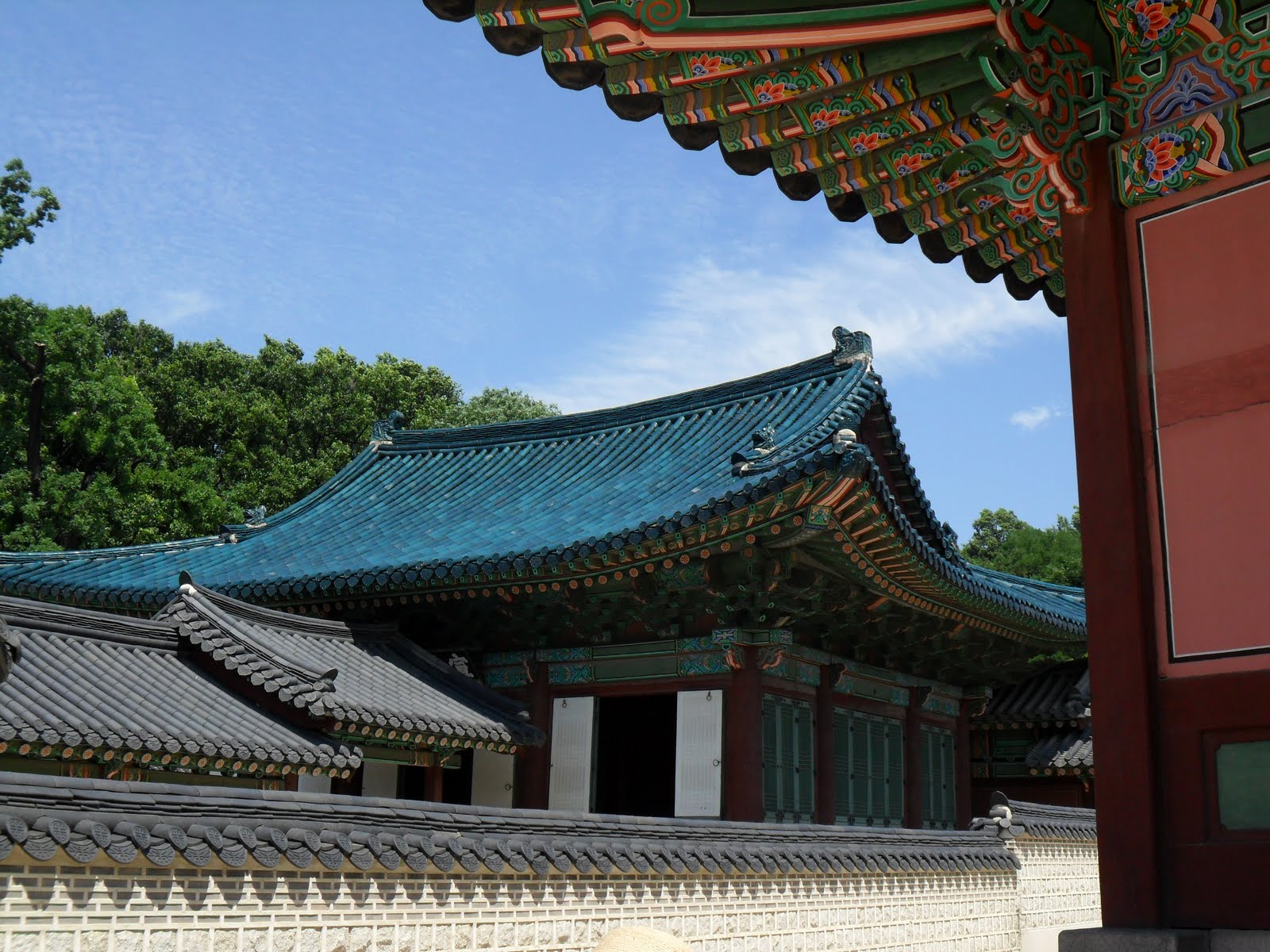
1. The building where the King lived is covered in blue tile because blue is considered the color of the ruler. Today, the president of South Korea lives in a mansion located near this palace called the Blue House.

2. All of the officials and royalty's buildings are painted with the traditional blue, green, red, white, and yellow that represent north, south, east, west, and power. Only buildings associated with the royalty or religion (Buddhist temples) could use this color combination. The home where the royal family lived during and after the occupation are not painted in these colors, but rather designed like the commoners house with plain white walls.
04

3. After the occupation, the descendants of the royal family continued to live here. Because of the political unrest and poverty of the country after the Korean War, they did not receive any money from the government. In order to survive, the former Queen and her daughter, the woman that would have succeeded the throne, worked with the tourism portion of the palace, leading tours of their ancestors home.
This palace is such a contrast from Gyeonbukgung. Gyeonbukgung is a huge complex with so many officials buildings and several compounds for the royal family to live in. Changdeokgung feels like a palace in the countryside. It is very peaceful, you cannot hear the sounds of the city even though you are in the business area of the city. You can really picture what life must have been like for the Joseon royalty walking around this palace.
Monday, July 18, 2011
Boryeong Mud Festival
On Saturday, I joined Woosik, his cousin, and three of his cousin's friends from school in England to visit the Boryeong Mud Festival. Boryeong is very close to Daecheon, the beach that I visited in May. It is about two hours southwest of Seoul by bus right on the coast.
We met at the Seoul Bus Terminal, which is about an hour from the Byeons. From there we took the journey south by bus to the festival. When we arrived at the festival, we saw mobs of people covered from head to toe in gray, mineral rich mud. It was quite a sight to see so many people covered in mud. It almost looked like some thriller movie gone terribly wrong: "Return of the mud people." Most of the people there were adults, and there were hardly any Koreans. I think this festival has turned into a foreigner activity.
The mud that makes this festival so famous is considered rich in minerals, courtesy of the abundance of hot springs in the area. Many Koreans come to Boryeong to go to the hot springs and have a mud bath. Boryeong is the place in Korea if you want mud that is considered good for you. I'm not sure if it is really as beneficial as the locals make it out to be or if it's just a way to get tourists, but the area is so beautiful that it is worth seeing with or without mud.
It was the first day of the festival, so there were hordes of people. The festival was located in sight of the beach. There were huge inflatable slides, obstacle courses, and pools filled with mud. Because it was so crowded, we were only able to do half the things we wanted, but it was still an interesting experience. After playing in the mud, we washed off in the ocean and relaxed on the beach before making our way back to the chaos of the city. It was nice to return to the countryside where there is little smog and life moves at a slower pace.
Subscribe to:
Posts (Atom)