This afternoon while looking at the news online, I received shocking news: Kim Jong Il has died. He died Saturday, December 17 at the age of 69.
North Korea announced the death of the Dear Leader on the North Korean national news this afternoon. According to the news report, he had died of physical and mental over-work on a train. Most likely, it was the result of his severe stroke that he suffered from in 2008. The reporter was wearing a black Hanbok (which surprised me because traditional Korean mourning clothes are white) announced the news in an emotional address. His funeral will be next week, with this week being a time of mourning for the people.
The news came as a shock to the South. While many Koreans believed that his health was deteriorating quickly, he has been quite active, making a visit to Russia last summer for the first time in five years and a trip to China as well. He didn't look too well on the video of the Mass Games, limping up to the podium, but he was still very active in the North's politics.
The president of South Korea has set a high security alert today as we wait to see how the North reacts to the news. Many of my Korean friends were shocked by the news and seem more concerned about this than the attack on Yeonpyeong last year. I think the South understood Jong Il's motivations and reasoning for actions, so while he was hostile, they knew how to deal with him. It will be awhile until the South understands Jong Un, especially considering the fact that we didn't know anything about him two years ago.
The big question today is: What happens next for the two Koreas? With Jong Il dead, how will his son rule? I think the next few years will be very defining for North/South relations.
Kim Jong Un is not like his father. He does not appear as assertive and he is very young. Unlike his father, who slowly gained power and respect in the North's politics over the course of 10 years, Jong Un has gained ranking and influence in a very short span of time. Jong Il became the dictator around the age of 50, while his son is only about 28. As a result, it appears to most South Koreans that the people and leaders of North Korea do not respect Jong Un with the same devotion as his father. A fear of South Koreans is that the leaders of the North may not stand behind their new leader, resulting in chaos.
In addition, it appears that the people of the North are tiring of their government, especially with the recent famine this past summer. If the people of North Korea attempt to dispose of their government, I do not think Jong Un has enough dominance to contest it if he does not have his fathers advisers behind him. There could be a lot of unrest in the North if there is not unity of the people and advisers behind their new leader.
I fear that Jong Un may try to legitimize his place as leader by attacking the South at the start of next year. Of course this is just my first reactions and thoughts, so I am not making any predictions. It may be the case considering the Yeonpyeong attack seemed to be based solely on trying to unite the North when the devotion was waning.
I also worry that Jong Un may lose his grasp on power, and we will be faced with a more brutal communist leader much like the succession we saw with Lenin and Stalin in Russia. At least now we have known about Jong Un for a year, if we are faced with a new dictator, we will have to try to learn about him before we discover why he came to power by actions on his part.
I also believe that we are witnessing the beginning of the end for North Korea. I believe that the North will fall under Jong Un or his successor by brutal means. I think we will see this in the next ten years. The last time there was a pass of power, the North was in much better shape than they are now. Jong Un is not as good of a leader as his father, and to see how quickly and drastically the North deteriorated under his father is an indication of how bad things could get for the North. I pray that the South continues to earnestly protect themselves when the North attacks out of desperation and plan for unification, because I think it will happen very soon.
Showing posts with label Korea 3rd Semester. Show all posts
Showing posts with label Korea 3rd Semester. Show all posts
Monday, December 19, 2011


Friday, December 16, 2011
End of EV Regular Classes
This week marked several "lasts" for me here in Korea. I finished exchanges with my Korean exchange partners, after three semesters of meeting with over 50 different Korean students, I will not have another exchange.
On Wednesday, we had the closing ceremony for the English Program. We had a dinner with both the Korean and Internationals that live in GV. It was bittersweet to have one last dinner with everyone in the program. During the dinner, the program director gave out the end of term awards for the EV program, which includes: Outstanding International, Outstanding Korean, Best Suite, and Best Exchanges. Surprisingly, I was given the Outstanding International award, which came as a surprise to me! I was given a certificate as well as a giftcard to Mr Pizza (the best pizza chain in Korea, oh yeah!)
Today was the last day of regular classes in the EV program. This does not include my Korean class in the Chinese program. Nevertheless, this marks the beginning of the end for me as the majority of my classes come to a close. In my Korean speaking class, my teacher brought us a cake to mark the end of our class, celebrate December birthdays (me and Maiko), and wish us well as we leave SCH. My speaking teacher is one of the sweetest teachers I have had, she always tried to find new ways for us to apply the Korean we have thus far in different situations. From writing a weekly journal to her in Korean to watching Korean movies in class, she found new ways for us to learn more Korean.
In my writing class, we wrote memory notes to our classmates. It really hit me at this point that this semester is ending very fast. It was hard to write these goodbyes to my classmates, many who I have been classmates with since last semester.
After classes, we had a Secret Santa exchange with the other Internationals. We ordered food and played Christmas music, followed by a gift exchange. While this exchange was going on, we exchanged memory books for one another to sign. This made the whole "goodbye" concept to a new light. Five of the international students took their finals today and left for the States because of family emergencies. Like past semesters, it was very hard to begin these goodbyes, knowing that they will continue from here on out for several weeks. I feel like these goodbyes are more difficult this semester because I know that I will be saying more goodbyes as I prepare to leave Korea.
This coming week will be filled with studying, so I will be pretty quiet here on this blog. I hope that I can post something once I finish my exams as we approach my Birthday week as well as Christmas.
Tuesday, December 13, 2011
Hyundai Plant
Today I went with my Korean Business class to the Hyundai Plant in Asan. It is located about 20 minutes from school and is considered one of the most advanced manufacturing plants in the world. It assembles sedans for export, so the cars we saw today may be coming to a dealership near you!
When we arrived, we were given a brief introduction to the plant and then began our tour of the assembly portion of the plant. We saw the process from the first piece of metal used for the body being molded to completed Sonatas being test driven on a test track. Every 57 seconds, the Asan plant completes a vehicle.
One interesting aspect of this plant that is a key aspect of Hyundai is that almost all the assembly robots and tools used are made by other branches of Hyundai Group. Hyundai was formed as a Chaebol by Chung Juyoung, which is a company that participates in several different industries. Hyundai Heavy Industry Inc remains one of Korea's largest companies specializing in heavy industry today. Hyundai Shipbuilding and Construction are also very prominent in their respective fields. Today, each individual component of the Hyundai Chaebol is owned by a member of the Chung family. I find it interesting that Hyundai as a whole is a pretty independent entity because while its different industries are varied, they complement each other. There is little need for outside investment of the Hyundai group. It was quite a sight to see the robots used to assemble the cars bearing the Hyundai Heavy Industry logo, Hyundai building Hyundai.
Another interesting piece of this plant is that the plant recycles 100% of its waste water in refineries located on the plant grounds. Hyundai is moving towards becoming an environmentally friendly car brand, both in its vehicles and how the cars are assembled. I think it is a great gesture for Hyundai to live up to high standards of responsibility both in products and the assembly process.
I was ecstatic that my class could go to this plant, especially since I based my class project on the history of Hyundai. I find Mr Chung very inspiring and I like that his children have continued his legacy with grace. To see the company I have grown to respect in action so close to my school was awesome!
Monday, December 5, 2011
Living History
One thing that I am always amazed by in any culture is the opportunity to speak to older individuals about their lives and hear their stories. Talking to people from past generations is like receiving an accurate glimpse of history from a human perspective. I believe it is extremely important for us younger generations to listen to them and learn from their experiences. If we turn a deaf ear to their past situations and advice to us, we will repeat the trend of mistakes and tragedies that they experienced.
Yesterday after the Buddhist temple stay, I joined Craig, a Tennessee native and Poli Sci major who enjoys arguing politics with me, and our SCH married couple Lindz and Krist for some shopping in Dongdaemun. Lindz and Krist are truly each others best friend and soulmate. They are absolutely adorable and set a great example for our Korean students in our program of what to search for in a significant other. They encourage our Koreans to look past the superficial "types" they pursue and their naive approach to relationships to replace it with a search for a best friend who will accept them for who they are.
But back to Dongdaemun: Dongdaemun is a series of department stores practically on top of one another. It is like a 21st century market with 12 floor shopping centers in lines down the main street. It is a shopaholics paradise.
As we were walking from one store to the next, we were stopped by this elderly Korean gentleman. He began to ask us some questions about ourselves in perfect English, some of the best English I have heard in Korea.
We asked him about his life, and his eyes completely lit up. He began to share with us about how he fought in the Korean War when he was 20. He then worked with the USA army during the war and learned English. He shared more of his life and what it was like to be a child during the occupation, a soldier during the war, and a man during the economic development of Korea. It was one of the most incredible conversations I have had in my life. In five short minutes of talking to him on the street, my perspective South Korea's history became much more personal. He showed us pictures of him while working as a soldier, his face beaming with pride as we saw a very handsome young man smiling with some USA soldiers.
He is a true hero in my eyes, he has lived through one of the most dramatic developments in any nation in history and continues to share his story with everyone he meets. He thanked us as Americans for all the dedication the USA has had to Korea. He shook our hands and began to tear up as Craig (who comes from an army family) saluted him and thanked him for his service to his country.
I will never forget that short exchange with this man. His life story is truly amazing and to hear it from him was incredible. I hope someday when I reach his age I can share my life story, experiences, and advice to young people with as much grace as he did for me.
Sunday, December 4, 2011
Buddhist Temple Stay
This weekend, I went on a temple stay at one of the larger Buddhist temples in Seoul. I joined about twenty other international students from SCH on this trip. We went to Myogaksa temple, which is located in the heart of Seoul close to Dongdaemun market. I was very intrigued with doing a temple stay because I think it would help me understand Korean Buddhism better than any textbook possibly could.
We left for the temple Saturday morning. We were required to arrive by 2:30, so I joined a few of the internationals for one final non-vegetarian lunch before making our way to the temple.
When we arrived at the temple, we were given temple clothes to wear while we were staying in the temple. The clothes were a simple Asian style shirt and pants, very comfortable.
After everyone arrived and changed into temple garb, the main nun at the temple, Yeo Yeo, gave us an introduction to the temple and a brief overview of Korean Buddhism.
Here are some of the interesting things that she discussed:
1. Buddhism is not understood by monks and nuns as a religion (a means of salvation) but a way of life in order to have a peaceful transition to the next
2. Korean Buddhists believe in Nirvana, but Nirvana is a place for a soul to rest before beginning a new life. It is not a permanent place, but more like a rest stop.
3. Contrary to the concept held by most Westerners, Buddhists do not worship Siddhārtha Gautama as the only Buddha. Buddha is more of a state of mind, an ideal that every Buddhist is trying to attain. Siddhārtha Gautama was the first documented person to reach that enlightenment. Buddhists today turn to him as well as other humans that reached Buddha state for guidance as they seek enlightenment.
4. After Siddhārtha Gautama reached enlightenment, his teachings were documented. His early writings are the works that Southeast Asian Buddhists follow, while East Asian Buddhists read his later writings. This is why their concepts of Buddha are slightly different.
After our discussion, we went to the evening bell toll with the other nuns. As they chanted and helped us ring the bell, the sun was setting over Seoul. It was a very special experience for me to participate in a centuries old tradition overlooking one of the most modern cities in the world.
After the bell, we went to evening chant with the nuns. This was held in the main chanting hall, which is the largest building in a Korean Buddhist temple. We followed the nuns lead as the stood up and bowed, a sequence that they would do for every chant. Each chant called upon a different reincarnation of the Buddha to bring them enlightenment. I have never been in a Buddhist service, so to listen along and see the nuns chant was very insightful.
We then participated in a very traditional Korean Buddhist practice: the 108 bows. 108 is a very significant number in Buddhism. The reasoning for this number is quite interesting: In Buddhism, there are 6 characteristics that you must remove and replace with 6 other attitudes. 6x6=36. According to Buddhism, these characteristics must be removed in order to bring peace to your past, understanding to your present, and discernment for your future. These 3 times are relative and significant constantly in order to reach enlightenment 3x36=108: The removal of undesirable behaviors in your past, present, and future in order to be replaced by characteristics that will bring enlightenment. In Korean Buddhism, when you perform a bow, your knees, hands, and head must touch the floor (the 5 physical parts that help remove desires) For each bow we performed, we were requested to think about one aspect of yourself that is needs to be released. After performing the bow, we put one bead on the string. We performed the bow 108 times to string 108 beads on our necklace. It was brutal! You do good for the first 50, but once you reach about 80, you're legs are burning. It was a very unique experience for me, it gave me a lot of time to think about things that I know need to change in myself, not for enlightenment but just because they are not right as they stand.
(Side note, for all you Losties, remember the hatch with the 108 minutes? This is where the writers got that. I always wondered why they chose this number, but for Buddhism, that is the number of renewal, a new start, cool eh?)
After this series of bowing and removal, we were ready to eat! We had a nice vegetarian meal: rice, kimchi, cabbage soup, potatoes, bean sprouts, and sauteed mushrooms.
After dinner, Yeo Yeo introduced us to proper meditation and we had a practice round before the next mornings meditation. Traditionally, you cross your legs so that your feet rest on top, but for all us tall people, she modified it for us so that we would still be able to walk afterwards. You hold you hands in a circle like position, which is supposed to help you find enlightenment.
After our practice round, it was time to hit the sack...for five hours before morning bell ceremony. I was out as soon as I hit my mat!
At 4am, we were awakened by the nuns in the dark, cold morning for the bell ceremony. Both the evening and morning bell ceremony is to thank the world and every Buddha (which is inside every living creature) for the beginning and ending of the day. We listened as the nuns chanted and rang the large bell.
After the bell ceremony, it was meditation time. Nothing like sitting in a dark quiet room at 5 am and not falling asleep! Surprisingly, I was wide awake at this point and liked being able to sit in silence for forty minutes. It was a refreshing way to start the day, instead of rushing around with no time to think.
After meditation, we took a hike up the mountain (large hill) behind the temple. We reached a pagoda in time for the sunrise. It was a great way to start the day (seeing that we had already been up for about 3 hours at this point, amazing how much you can accomplish early in the morning!)
After the hike, we returned for breakfast. Pretty similar to the dinner, except we had rice noodles as well, yummy!
We then learned the Korean Buddhist traditional tea ceremony, which is slightly different from the Korean tea ceremony. After making some delicious green tea, we concluded our temple stay with a discussion with Yeo Yeo.
We left the temple at....10am....yeah....a six hour morning activity before the time I usually see daylight on a weekend. These Buddhists, they're on to something I tell you, now if only I could get myself to follow a similar morning routine, I would accomplish so much...
I have been wanting to do a temple stay pretty much since I came to Korea. It was so fascinating to me to live with these nuns and see their world through their eyes. They live in a reality where time is very relative, what you don't accomplish in this lifetime you can begin in the next. It is a concept that is so foreign to me, coming from a Christian background. I enjoyed hearing their perspective and learned an immense amount about Korean Buddhism.
Sunday, November 27, 2011
Shopping and Megachurches
This weekend, I had a Koreanized "Black Friday." I stormed all the major markets in Seoul as well as some of the famous bookstores. While people in the states were stampeding into Walmart, I was bargaining with street vendors at the markets.
Joining me for this expedition was Chelsea, a fellow international. We first went to the markets: Dongdaemun, Namdaemun, and Insadong. I have visited these markets on several occasions, but this was the first time to do all three in one day. It was epic! Between markets, we would snag some street food, which included pork and kimchi mandu (dumplings) and hotdok (a Korean pancake with cinnamon filling). All three of these markets have ancient roots, with Namdaemun and Dongdaemun paying homage to their historical roots in their names. "Nam" is south in Korean while "Mun" means gate or door, this market is located where the south gate of the ancient wall that surrounded Seoul stands. While the wall no longer exists, you can see the gate from the market. In the same way "Dong" means east in Korean, add "Mun" you get east gate, the place where the eastern limits of ancient Seoul were located.
After these three markets, we visited two bookstores in the city. The first was the Salvation Army Christian bookstore. I have wanted to visit this bookstore for awhile. It is the largest Christian bookstore in Korea and one of the largest in Asia. It was interesting to see some of the same literature that is in my dad's office being sold here. After this bookstore, we went to Itaewon to see "What the Book," a bookstore my friend who teaches here in Korea recommended to me. Basically, it is a large used bookstore that sells only English books. It is like a huge book exchange for foreigners. They also had a huge selection of books about Korea in English, now I've got quite a list of books to look for on Amazon! Chelsea was especially happy about this find: she's a literature buff and hopes to teach in Korea next year, I think she will spend a lot of time searching the shelves of this store!
After our shopping expedition we joined Ross and Victor, two of our classmates from school that were in Seoul for the day, for dinner in Itaewon. It was nice to swap stories from our day as well as to have dinner away from the Shinchang. Like any small town, after a few weeks, you grow weary of the same restaurants. Anytime we get up to Seoul, we like to eat something completely different.
We said goodbye to Ross and Victor after dinner and went to visit the Byeons. Kyunghye is finished with the Suneung (College exam) so we were able to spend time with her now that she has a break until February. We watched a Korean movie call "Sunny," which left me with mixed emotions. The storyline is basically about a group of seven high school girls who form a club called Sunny. The story is told in flashbacks of their "Sunny" days as students, and the present day where they are trying to find one another as one of the members is dying. Watching this movie as a person in the in between time (high school and middle age) I felt a bit of longing for the memories I have as a teenager with my own "Sunny" like group. It also made me wonder, fifteen or so years from now, will I be faced with the same reality as these girls: losing touch with those friends that meant everything to me as a teenager resulting in a search for them? While nothing can remain the same as it was, I still in a way mourn for those memories in that they will never return as they were. Oh, why is growing up so difficult! It was nice to see this movie with Kyunghye because even though it has been five years since she came to America and became a sister to me, we still have the same quirkiness as before, an indication to me that while our lives may change, friendship can remain with the knowledge that some things will change but others will hold the same.
On Sunday morning, me and Chelsea completed another thing off my list of things to do in Korea: we went to Yoido Full Gospel Church. Yoido is the largest church in the world, with over 1,000,000 members. If you asked 10 people in Seoul where they went to church, at least one would say Yoido. It is a monster of a church, with a huge stadium sanctuary on Yoido island right next to the National Assembly. I find it interesting that these two titans stand side by side: The Political power(Natl Assembly) and the Religious force (Yoido Full Gospel). They are the two forces that are deciding the future of this nation, from collective policy and individual conviction standpoints.
We were led from the main welcome area to the section of the stadium for foreigners. We were given headphones to listen to the translation of the sermon. It was very helpful for me to hear the more particular details of the pastor's sermon because I was very curious to finally hear a message from this controversial pastor (more on that in a minute). I also really enjoyed taking off the headphones for the rest of the service to sing with the 15,000+ worshipers at the service. Singing with a mass congregation in Korean was an incredible experience. In the course of 60 years, Korea has demonstrated that a nation can turn to Christ (less than 5% Christian 1950 to over 50% today.) What was mind-blowing about this church is the magnitude of the church. There were 15,000 people at this service, not counting the several thousand that were watching a live stream of the service from satellite churches outside of the city. In addition, this was the fourth service of the day, with an additional three in the afternoon. The church holds at least one service a day. Korea definitely likes to demonstrate extremes, this church is another example of that!
Now, to the actual message and some of the troubling things I found in this church. First off, the church is a perfect example of a church revolving around a charismatic senior pastor. I think I have mentioned this before, but a lot of Korea's churches focus their ministry around their pastor instead of their faith statement and community of believers. The founding pastor and his son pretty much run this place, and the majority of churchgoers regard their words as truth. Instead of emphasizing faith as an individuals journey that can be encouraged through the community of believers by means of church, Yoido focuses on a personality cult of sorts through Rev Cho.
Another fascinating aspect of this issue I have is that pastors in South Korea do not pay taxes on anything and do not have to report their income to the government. Can you see the potential for corruption? You have a congregation that believes you can do no wrong and a government that will turn a blind eye to any potential misguidance of income, what do you think the result would be? I do not think any human is capable with that much power to not turn to greed. The father son duo at Yoido have been accused of stealing millions from the congregation. However, the people are defending them and refuse to believe they have stolen from them.
I think what is more frightening to me besides the pastors stealing from their own members is the message they preach. The main message of this church is what they call "Three fold blessing: the blessing of spirit soul and body." They proclaim that physical health and financial gain are as significant to God's will for believers as the salvation of the soul. This message was preached in the sermon today, when Pastor Cho discussed the story of the ten lepers. He used the example that if we give thanks in all we do, we will be healed like the thankful leper. Now, first of all, all the lepers were healed before anyone said a thank you. Secondly, to put God in this small box of "if you do this, God will do this for you" is not only extremely disrespectful, it is harmful to yourself. With such a naive understanding of God, I do not know how a person would be able to deal with troubles when they come. Jesus promised that because of your faith, you would have troubles, never did he say that if you believed enough or gave thanks often enough would he bring you wealth on this earth. God is God, and while we may not understand some of the things that happen to us, we can count on Him to stand by our side, through the good and the bad. To promise people that they will be successful if they are good enough is completely contrary to what Jesus preached.
I pray that this church survives this scandal and comes out of it pursuing a message that is more like the message of Christ. I also pray that every member of this church forms individual convictions and a faith of their own, rather than a mass misinterpretation of the Bible.
Thursday, November 24, 2011
What are you thankful for?
Happy Thanksgiving from Korea! I had a very eventful Thanksgiving filled with laughs. I had Korean class this morning followed by an afternoon of exchanges. This evening, I had Thanksgiving with a group of internationals, more on that in a bit.
I woke up a bit late, so I didn't have time to eat a real breakfast. Of course, since I was hungry, the lesson in Korean today was discussing food. Ain't it always the way!
After Korean, I joined my classmates John and Dan for lunch in the cafeteria. We had a very random discussion covering Twilight (which Dan read, very surprising to me, I can't stand the series) to Harry Potter to Star Wars. It felt like the random discussions at the family table on Thanksgiving day, my first real reminder that today was Turkey day.
After lunch, I had exchanges with Korean students. A few of them didn't show up because of all their projects. There was a group of us internationals down in the exchange room waiting for exchange partners. We had some good discussions both with the Korean students as well as internationals about Thanksgiving.
After this, I went out for a real legit Thanksgiving....well....maybe not too legit.....I joined a group of internationals (Kayla, Ben, Martin, Amanda, Chelsea, and Chester, who is Korean but we joke is more of an international than us) for dinner at Popeyes. Ok, I know what your thinking: "Popeyes, come on, you can be more creative than that." Well, we wanted a bird for Thanksgiving so this would suffice. Our table was filled with fried chicken, biscuits, and fries (they don't have mashed potatoes in Korean fried chicken places, so sad). After our feast, we went out for some ice cream for our dessert, even though it was around freezing all day. We had a pretty decent dinner: the bird, potatoes, dinner rolls, dessert, and SCH family. We spent the whole dinner laughing and discussing all the stories from Global Village.
This was my second Thanksgiving away from home. While there is no substitute for family, I feel very fortunate for my family here at SCH. We are very much like a family: while we have disagreements and sometimes just don't get along, we still care for one another as we continue this journey in Korea. Spending Thanksgiving with this wonderful group of people from around the world has been very memorable. Last year, I celebrated with a completely different group of people, yet we gave thanks for the blessings in our lives just like we did this year. It is pretty cool to give thanks with people who have different backgrounds from you, yet you all can join together to be grateful for the year as you look to the future.
On this Thanksgiving, I am thankful for many things:
I am thankful to God for His faithfulness to me and especially this year for all the twists and turns He has thrown at me so far in my life.
I am thankful for my family who have loved me unconditionally and supported me all through my life and through my journey in Korea.
I am thankful for my friends, both in Korea and around the world, who challenge me and encourage me to pursue my dreams.
I am thankful for this opportunity to continue my studies in Korea for an extended period of time.
Happy Thanksgiving everyone!
Wednesday, November 23, 2011
Winter and Remembrance
Today officially marks the beginning of winter in Korea: it snowed! We have been teased with near freezing temperatures and chilling winds, but today there was a glimpse of snow among the rain. Last year we didn't witness snow until December, so this was a bit of a surprise.
Today also marked a significant anniversary here in Korea. A year ago today Yeongpyeong Island was attacked by North Korea. For those who may not have read my post about the attack, I will give a brief recap:
The waters surrounding Yeongpyeong are contested by both sides on ownership. It is a island with the coast of the North 7 miles away. This area has been a prominent argument between the two Koreas over fishing and trade rights. These waters between the South, North, and China was also where the Cheonan ship sunk in the spring of 2010. The water borders aren't as defined as the land borders, thus there are many skirmishes annually. In addition, most defectors from the North cross to the South by this waterway. This area has been one of the main indicators that the Cold War emotions are still very raw.
The week of the attack, South Korea and the US army conducted joint drills, an action that the North loathes. The North threatened retribution for this action, yet the drill continued.
Yeongpyeong is the largest military post on this sea region of the border. Before the attack, it was considered one of the most dangerous areas of the border because of all the sea disputes and defectors. Yeongpyeong is also home to around 1,600 civilians that use the island as a base for their fishing businesses.
The afternoon of November 23 brought about the most deadly and violent attack on a civilian region since the end of the Korean War. According to the South, the North fired on Yeongpyeong first. Their side of the story states that the North began to shell the island with their Cold War artillery, leaving the South's troops completely shocked. The North claims that the South fired first and their attack was a response.
50 shells from the North hit Yeongpyeong, killing four marines and seriously injuring five. The South responded with 80 rounds of artillery to its Northern neighbor.
A year later, the South has a clear belief and in my opinion accurate belief of the motive for the attack. The North hates the joint drills the US and South Korea annually hold, and this specific drill was directed towards that Northern coast past Yeongpyeong. It seems that the North decided to return this practice attack on its coast with a literal bombardment. In addition, this attack took place three months after Kim Jung Un was introduced to the world. According to Western journalists who were invited to the Mass Game that introduced this future dictator, the people were not too enthusiastic about this new leader and had to be coaxed to cheer. A few months ago, the North released a statement that basically said:
"The noble attack of Yeongpyeong by our mighty army was led by our courageous Comrade Kim Jung Un. Under his bravery, we were able to face our enemy with force."
In a nutshell, they contribute the attack to Kim Jung Un, which is a huge plus for this emerging leader. The new Kim must get his people behind him or his regime could collapse before it begins its governing. Whether the main motive was to intimidate the US/S Korea alliance or to build propaganda for Jung Un, there was a reason for this attack.
President Lee held a memorial in Seoul for the fallen today. A year after these attacks with a major presidential election early next year, I am curious to see how the relations between the Koreas will change. Alright, I'm going to get very political here, these are my opinions from what I have observed:
President Lee has held a very black and white stance when dealing with the North. Unlike the past few presidents, he has made it clear that he will not tolerate the North's policies and displays that by pulling aid to the North. This is a stark contrast to the past two presidents, who initiated and promoted the "Sunshine Policy" which basically was the premise that if the South helps the North through aid and encourages joint economic ventures, the North will ease tensions and call for unification. While I think unification should be a priority for the Koreas, the South must be careful in not allowing that desire to inhibit their ability to view the North Korean dictatorship as dangerous to the South. Tensions between President Lee's administration and the North has been very tense, especially with the depletion of aid. With an election next year, both Koreas will be watching as the South chooses a new leader. The leading candidate for president here in the South is the daughter of the late President Park, who is considered the greatest president in the South's history. She is a member of President Lee's party, so her beliefs are very similar to both Lee's and her fathers. If elected, she will be the first woman president in the South's history. With a change in power for both Koreas in the next few years, it will be very interesting to see how the dynamics change.
I guess the only other thing I would like to say in this post is my personal feelings about this memorial as a foreigner that has lived and grown to love Korea. When this happened a year ago, I was on my way back to school from a conference in Seoul. We were watching the North shelling the island live, helplessly watching the black smoke rise from the fires. To know that this was happening 60 miles from where we were offshore was an experience that I have never had. To be that close to a conflict between two armies that have been technically at war for over fifty years was quite terrifying. Our teachers seemed concerned, but reassured us that conflicts between the two have been ensuing for years and its something you have to learn to deal with living here. Looking back a year later, I am reminded that this is the reality for South Korea: As long as their neighbor continues Cold War hostility, there will be a constant threat right next door. Living here for almost 15 months has taught me to see life like Koreans: we have dangers and threats all around us, we do not know when our time to leave this earth will be, but in the meantime, we must keep living. The resiliency and determination of the Korean people to not let this dark cloud that looms in the North define them has inspired me to see each day as a gift and to not be afraid of my "North Koreas" so to speak.
Sunday, November 13, 2011
Weekend in Cheonju
This weekend, I went to Cheonju with my suitemates. SCH sponsors a weekend trip for suites to travel to a nearby region of Korea together. My suite decided to go to the neighboring province of Jeollabukdo to visit its largest city. Cheonju is a very old city that has a population of about 500,000. It is famous for having well preserved Joseon architecture and the most delicious Bibimbap in Korea.
We took a 2 hour bus from school to Cheonju, which is located in the central region of Korea. When we arrived, we ate the famous Hwae Bibimbap at one of the oldest restaurants in the city. Hwae Bibimbap is a little unique in the region in that the meat is raw beef. You are served steaming hot Bibimbap where the meat cooks halfway as you are eating this spicy specialty. It was very tasty, most likely the best Bibimbap I've had. I liked how as you continued to eat, the meal changed in that the beef began to cook. It was a unique experience to eat something that was literally still cooking as you were eating.
After lunch, we went to Homeplus, which is the main competitor with Emart as the dominant Walmart-like store in Korea. We bought food for dinner to cook at our Hanok (traditional Korean house) as well as some breakfast. I always find these stores intriguing to see the products that are viewed as normal items. It is interesting to see no ground beef, yet there is an abundance of packaged squid, octopus, and Asian vegetables. It is a sight that I would never see at home, even at our Asian market. This completely different environment is what keeps me curious about this place, I am constantly learning in every situation.
After purchasing our dinner, we made our way to the Hanok. We met one of the boys suites from school there. They had a late start and missed the Bibimbap, but they made it in time for dinner and the evening activity. We had a squid stew along with Budaejigae. After dinner, we learned more about traditional Korean teas and the customs when drinking tea. Last May, I went to a tea farm and learned this ceremony, so this was a nice refresher for me before I go home and make tea for my family. I feel like a very educated traditional tea maker (would that be the right term....hmmmm...) We also learned how to do the traditional bows. For women, your right hand goes over your left, smoothly sit with your legs crossed, and move your hands up to meet your bowed head. If you are bowing to the dead, your hands are reversed. For men, left hand over right, smoothly get to a kneeling position, hands on the ground and head meets the hands. For the dead, hands are reversed. It was really cool to see my suitemates and the Korean guys perform these bows that come so naturally for them. This is the bow they perform for their relatives on Chuseok and Lunar, much like our tradition of hanging ornaments at Christmas. I was not too skilled at this bowing action, but not too bad for a beginner.
After this tea activity, the boys decided to go buy some Soju and drink with some of the girls. Because I have disagreements with the way the drinking culture is carried out here in Korea, I spent the evening partially with them, and then took a walk out in the brisk cold of the village in reflection under a very clear sky. It was good to clear my head after a couple weeks of nonstop action between planning events and studying for midterms.
The next morning, we had Jinramen (spicy ramen, great way to clear the senses in the morning!) for breakfast. We then learned how to make Korean rice cakes. We pounded rice to make the dough and rolled it in a flour like powder, resulting in a tasty morning snack!
We then went to an ancient Confucian school located in the city limits. It has been around for almost 800 years. What was also pretty cool about this location (apart from its amazing historical significance), I know I'm gonna sound like a thirteen year old...oh well....one of my favorite Korean dramas Sungkyungkwan Scandel was filmed here! Locations for dramas are a huge deal here in Korea. Loyal fans will make pilgrimages to these ancient sites not for the cultural and historical aspects, but for the fact that their favorite dramas were filmed there. I saw several Korean couples attempting what looked like a reenactment of some of the more famous scenes from the drama, obsessed fan a bit much I think? I really liked the fact that this was one of the founding schools of Confucian thought in Korea (along with Sungkyungkwan, ironic). It was neat to see the spirit tablet shrines where scholars from the past are buried. This city has so much history and unlike Seoul, it is not as touristy with foreigners flocking every corner, this feels more like Korea.
After visiting the shrine, it was time to make the journey back to school. We just missed the hourly bus to Cheonan, so we arrived to school quite late (around 8pm). I was exhausted at this point, but it was a great weekend touring a new area of Korea with my amazing suitemates.
Thursday, November 10, 2011
수능 (Suneung)
Today the sound of silence gripped Korea as high school seniors took the 수능 (Sunung). The Suneung is the college entrance exam in Korea. It is a six hour test that determines the universities you can apply for depending on your score. The subjects covered include: Korean, Math, Social Studies or Science, English, and an additional foreign language. The Suneung is only offered once a year, so students prepare from early morning to midnight everyday for about a year to take this test.
Korea has the highest percentage of young people attending and graduating from university, to the competition to enter a good school is severe. In addition, Koreans have high respect for the top 5 schools (Korea Advanced Institute of Science & Technology,Seoul National University, Pohang University of Science & Technology, Yonsei University, and Korea University) but not too much for other universities. While finishing higher education is commendable, most employers would hire a graduate from one of these schools without looking at the other aspects of the resume before considering a graduate from another school. The emphasis is not on how well rounded you are, the focus is on the tangible aspects that are attributes for potential success.
As a result of this clearly defined standard of a good university, the Suneung determines which students can apply for these schools. In addition, since the majority of students attend university, the few that do not pass the Suneung must find their way in a society where not attending university is the minority. It is quite a phenomenon where those that choose to live simple honest lives is considered the road less traveled.
Because this test is such a defining point in students lives from a Korean standpoint, the government instills several measures to ensure that test takers can focus solely on the test. One example is that Incheon International Airport diverted and delayed landings during the test to ensure students were not distracted by the sounds of incoming planes. Another example is that officers closed roads that were close to schools where students were taking the test. This test is almost an unofficial holiday in a way because much of everyday life is modified to fit the needs of the test takers.
There is so much emphasis placed on passing this test. The pressure on students to excel in this test is very high. As a result, there have been tragic consequences. Suicide among high school students in Korea is one of the highest in the world. This was displayed this morning when we woke up to the news that a high school student in a neighboring town scheduled to take the test committed suicide. I think it is crucial for parents to keep things in perspective for their children: this test does not define them and their future does not solely depend on the results of this test. More importantly, regardless of the results, the student is loved by his/her parents and they will continue to provide moral support as they pursue their future.
Wednesday, November 9, 2011
Halloween Party
This years GV Halloween Party was held at school in the Student Union building. It was pretty tight, but it worked nonetheless. Friday afternoon before the party, I joined the rest of the "Halloween Committee" which was a group of students who organized the party to decorate the hall. We managed to find a party store that had a good selection of decorations, so the hall turned out pretty nice.
At the party, we included some events that you would see at any Halloween party included a pumpkin carving contest and a costume contest. It was great to see the Korean students embrace these events, the costumes looked great and they did a good job for carving for the first time. This year, I was quite busy with the logistics of the party, but I still had the chance to see the students working on their pumpkins.
Overall, I think the party went very well. My fellow GVers had a good time and everyone got to enjoy a "foreign" holiday.
Monday, November 7, 2011
Weekend of family time
This weekend, I went up to Seoul to spend time with Imo, Uncle Josh, Jinyoung, and Eujin. I have not seen them since August when they surprised me at the airport on my way back to Korea from Hong Kong. They are one of the sweetest families I have known and I was well overdue for a visit.
On Saturday, I arrived at their home and met their friends from church and their two adorable girls. We played card games which included Spoons, Go Fish, Kings Corner, and Old Maid, which we gave a new name to: "Ajumma" (which means a middle aged woman, usually single, pretty much the same as the original name). After a few card games, we went out to dinner for barbecued duck.
The next morning, I joined the family for church. We went to Uncle Josh's church, which is about a ten minute drive from their home. I attended the English service with Josh and Jinyoung, which is the service they usually attend for several reasons. One, because they want to improve their English. The other reason is that the senior pastor of the Korean side of the church is accused of stealing church funds for his lavish lifestyle and is awaiting sentencing. Despite his guilt of stealing from his own church members, most of the members are defending the pastor's actions. This is a rampant issue in Korean churches: the congregation attends the church for the pastor, not for the community of believers. Pastors of mega churches have a reputation for corruption and dishonesty in Korea. I find it tragic that the men that are entrusted with the duty to lead groups of believers abuse their power and sin against the people they are told to encourage. I hope that Josh's church will recover from this scandal and unite in the faith, not the pastor.
I enjoyed worshiping with another group of Christians. It was nice to attend church with Jinyoung and Josh. After our service ended, we went to pick up Imo and Eujin from childrens church. After church, Imo made a delicious seafood soup for lunch. After lunch, Eujin showed me his Halloween costume, Spiderman. In addition, he defended us girls from the evils of Josh as they fought one another in the living room. After this action sequence, we played a few more rounds of Kings Corner before I had to leave for school.
Thursday, November 3, 2011
Sudeoksa and Apple Orchard
Today, I went on a fieldtrip with the entire Chinese program (when I say Chinese program, I mean the more intensive Korean language program. The majority of my classmates are Chinese, so this is what the program is usually referred as). The Korean teachers decided we needed to get out of our classrooms and go see some local sites. I was very happy to have a day off classes and spend the day outside with my class, especially since we had some freak warm weather, highs in the lower 70's! Very strange for November, but I'll take it.
We first went to Sudeoksa, which is one of the larger temples in the area. I had not been to Sudeoksa, so I was very excited to visit a new temple and find the unique nature of this specific temple. When we arrived, I was overwhelmed by the utter beauty of the season. The leaves were a kaleidoscope of reds, oranges, and yellows. Walking up to this temple with the typical bright greens and blues among these warm colors on the trees was very contrasting yet had a sense of harmony.
The temple is quite active, in that there were several services going on in the main chamber as well as the shrines located around the complex. There were about ten monks making their way around the temple as well. The temple was located on top of a hill overlooking the colorful trees below. Hearing the chanting and seeing the seasonal grandeur was a real highlight.
After we left the temple, we made our way to an apple orchard. We first made our way inside the main building to bake a pie. I was beyond excited about this! I had been craving apple pie for a week and now we were going to make one with fresh apples from the farm. It was my Chinese classmates first time to bake their own apple pie, so it was fun to see the joy and curiosity on their faces as they rolled the dough and put their pie together.
While our pies baked, we visited the cellar of the farm which housed several barrels of apple wine that the farm makes as well. It was another deja vu moment for me of home. Hearing the farmer talking about fermenting the apples reminded me of the wine tours in central Missouri.
After this tour, we ate lunch before getting ready to pick apples. We had a nice Korean lunch of Japchae, pork, and homemade Kimchi. It was then time to begin the apple harvesting. We were allowed to pick 5 apples to take home. I was determined to find the most beautiful apples in the orchard. After a very thorough search, I selected my fruit to take home.
Tomorrow is the GV Halloween Party, I will discuss more about the party as well as all the preparations that have been going on later...
Thursday, October 27, 2011
Done with Midterms!
Alright, the week of studying like a Korean and test taking is over! This week, I had three Korean language exams, a marathon of language study. I didn't have other regular classes or exchanges, so it was quite a weird week. I think the exams went alright, I won't know my results until next week at the earliest.
I find it hard to believe that I am halfway through this semester. What's more, I have about two months left here in Korea before returning to the States to finish my degree. My emotions this whole semester have been varied because of this imminent move. I am very excited to see my family after about 18 months of being away, yet at the same time, seeing my family means leaving my family here in Korea. Returning to my home country means leaving this place that has both fascinated and inspired me. I suppose that is life: unending goodbyes with the hopes of having hellos once again. Life is a journey with various people and situations coming and going, yet you must press on. I hope that I can fill these next two months with many meetings with friends and new experiences.
I find it hard to believe that I am halfway through this semester. What's more, I have about two months left here in Korea before returning to the States to finish my degree. My emotions this whole semester have been varied because of this imminent move. I am very excited to see my family after about 18 months of being away, yet at the same time, seeing my family means leaving my family here in Korea. Returning to my home country means leaving this place that has both fascinated and inspired me. I suppose that is life: unending goodbyes with the hopes of having hellos once again. Life is a journey with various people and situations coming and going, yet you must press on. I hope that I can fill these next two months with many meetings with friends and new experiences.
Tuesday, October 18, 2011
Chungnam Techno Park, Dog Meat, and Kimchi Making
This past week has included some unique cultural happenings apart from the Sports Festival. I suppose I'll start with the earliest....
Last Tuesday, I committed an act that some of you may deem unforgivable: I ate dog meat. Alright, let the initial shock and horror sink in and hear me out. First off, I love dogs, they are great pets and companions. I think that people that abuse any animal is disgusting. Ok, so why would I eat a dog? Dogs are animals. I believe that if an animal is raised as livestock and killed humanely for consumption, there is no distinction or partiality between animals. Korea has raised a particular breed of dog for its meat, thus it is like a pig we raise for bacon. It is livestock. I have lived in this country for over a year, but I had not tried eating something that many of my Korean friends enjoy. There are certain lines that I refuse to cross (ex. bowing to my friends dead ancestors and giving them ricecakes) but when it comes to food, there are very few things I would refuse to try.
So back to Tuesday: My Korean business teacher invited my class to come with him to dinner to try dog meat. We went to a small restaurant out amongst the rice fields to a little mom and pop shop famous in Asan for dog meat. Our teacher ordered a small plate of the meat for us to try along with some side dishes. I thought the meat had the texture of Veal, yet the taste of a combination of Mutton and Pork. Pretty tasty, but seeing that a small plate of it costs roughly $30, I think it will be a one time thing until I come back in the future.
Yesterday, I participated in a yearly school event for foreign students to learn how to make Kimchi. The amateur made Kimchi is then donated to a homeless shelter in Asan. There were about 10 international students participating this year. Kimchi is pretty straightforward to make once you have a good mixture of chili paste. Green onions, garlic, and sometimes seafood (little shrimps) are added to the chili paste to create the right combination of flavor. After you have made this paste, you spread the paste on the cabbage leaves and store it in a cool place for about a year to ferment. You can eat freshly made Kimchi, but it isn't as nearly as tasty without that aged fermented flavor.
In the middle of the Kimchi making party, the president of the university paraded in to pose for some publicity photos with us foreigners. It is always weird to be in school propaganda pictures with us token foreigners, the indication of diversity on campus. After posing with the Kimchi and saying "Kimchi" (which is what you say in Korea instead of "Cheese" making it ironically appropriate for this fermented photo shoot) over a dozen times, we went inside for some Bibimbap provided by the school for this event.
I'm glad I had this chance at a crash course into making Kimchi, seeing that I will be coming home very soon. I will most likely crave Kimchi constantly since it has been the constant of my diet here in Korea. I eat Kimchi for at least two meals a day, at the Byeons every meal. I have become a bit of a Kimchi snob in that I have great contempt for store bought Kimchi. Just like food at home, homemade Kimchi puts the best store bought brands to shame. I want to make my own Kimchi in the USA for those days that I am missing Korea terribly, which will be a lot so I will need to master my Kimchi recipe before leaving.
Today, my business class took a fieldtrip to Chungnam Techno Park, which is the largest Technology community in my province of Korea, the "Silicon valley" of Chungcheonamdo. Korea is home to over a dozen different Techno Parks, each with its own individual technological focus. Chungnam is famous for innovating 3D movie technology. Basically, they contract with Hollywood to convert both old and new movies into 3D format. We watched a few examples of some of the movies they have converted (including Transformers 2, the upcoming Titanic rerelease into 3D, and Saving Private Ryan, which would be extremely intense in 3D). We also had the chance to see some of the other moviemaking aspects included in this Park. We watched a team work on clay animation as well as a sound editor working on a new show for EBS (Educational Broadcast Station, the PBS of Korea). The program for EBS is an animated feature about dinosaurs that lived in Korea. It is geared towards kids, but it was quite intense! I guess Korean kids are more brave than I was when I was little, for petes sake I had nightmares from "Babe!"
Next week is Midterms, so the next few weeks will be a little out of the ordinary with no exchanges. It has also gotten a lot cooler, mid 50's, these past few weeks. I have not broken down and brought out my coat quite yet, but I have a feeling it will happen pretty soon.
Saturday, October 15, 2011
Fall Sports Festival
Today was Global Village's annual Sports Festival. This semester, there were four teams of a combination of guys and girls suites. My suite was on team A along with five other suites.
The games were held in the gym this semester, which was nice considering it was cold and rainy outside. We had five events this semester: Human bridge (my personal favorite), relay races, tug of war, pass the cup, and mini games (individual basketball shots). After a practice cheer round and warm ups led by Sanghyeop, one of our coordinators, we began the games.
I played in tug of war, human bridge and pass the cup. Because there were so many people on each team, each person only had to play in two or three games. It was fun to cheer the other events. Last semester, everyone had to play everything, and I didn't have an opportunity to watch other games.
My team took first place overall, however we did not have as much team spirit as group D, which was led by our British student Richard in cheers with a giant blue trash tub. I think he picked up a few ideas from the soccer game last week, coordinating motions with the cheers. Sadly, good cheering doesn't equal good athletics, his team placed last among the four. However, his team would win "best team spirit" award for sure.
After a fun time with all the students living in Global Village, it was time for lunch! We had some BBQ along with some good Korean food (Lots of Kimchi). At the luncheon, I ran into a former student that was here my first semester, Greg. He studied at SCH for two years and is pretty fluent in Korean. He's teaching at a Hogwon (private school) in the middle of the countryside. It was fun to recall memories from my first semester and to catch up with him and hear about his time in the USA before coming back to work in Korea. It is interesting how my path is crossing again with some people I met my first semester. It makes me feel like I have been here a lot longer than I have, seeing people complete one phase of life and begin another.
This coming week is regular classes and next week is Midterms. It will a busy few weeks with tests and projects due, but I hope to go visit some family after my exams, just in time to celebrate with Kyunghye over her completed college entrance exam!
Sunday, October 9, 2011
Football Game and Sunkyungkwan
This weekend, I went to Seoul for the first time in a month. On Friday, Korea's national football (soccer) team played Poland. I went to see my first football game in Korea along with about fifteen other international students from SCH.
We left school after classes around 3pm and made it to the stadium by subway around six. Once we arrived, I went with Richard to get the tickets while the rest of the group bought some pizza for the group from Homeplus, a Korean Walmart. We made reservations online so we had to pick up our tickets. As we made our way to the ticket booth, we saw floods of Koreans in red Korea jerseys for the game. The energy surrounding the stadium was unbelievable. Do not get between Koreans and their soccer!
We made our way back to our group, ate some pizza, and then entered the stadium. The enthusiasm in the stadium was even more intense than outside. We sat on one goal end, and at the other side was a coordinated cheer squad that was leading the crowd in cheers. Some of the most memorable cheers included yelling "Korea will win" to the tune of Beethoven's Ode to Joy, singing "Ariyang" Korea's most cherished folk song, and a combination of singing and jumping with team flags being flown in synchronization to the tune. I found the cheer squad just as exciting as the game!
There were probably about ten Polish people near where we were sitting. Poor things were so outnumbered. The end score was 2-2, since it was a friendly match, they didn't go into overtime. After the game, the team did something that I thought was really cool: they went to each side of the stadium and bowed to the fans. They walked from goal post to the side stands and gave each group of fans a bow of both respect and gratitude. I thought this was one of the most touching things I have seen in a sporting event. Regardless of win, loss, or tie, the team thanks the people who support them through it all: the fans.
After the game, I helped a few of the students to Seoul Station to take a KTX back to school. I then went over the Byeons for a visit, the first time I've seen them since leaving for school. I got there just as Kyunghye was returning from studying. We chatted for about an hour before Hyesun got back. It was so nice to see them again after about a month away.
Saturday I went to Sungkyunkwan University, the oldest university in Korea. Founded in 1392, it was a place where Confucian philosophy was taught to the brightest of the Joseon dynasty. In Joseon society, scholars were second to the King, even above the Yangban (upper) class. This displays the stress and reverence Korea has always had for education. This is one thing I really admire about Korean society: the desire for power or wealth comes second for the thirst for knowledge. Koreans have known throughout history in order to be successful, one must realize the value of learning. Because Koreans were great thinkers, they accomplished a lot of scientific feats as well as built a stable society.
Sungkyunkwan continues to be one of the most distinguished universities in Korea. It is a pretty cool place. As you approach the school, there are hints of a college town: cheap restaurants, boutiques, places for nightlife, etc. The school is separated into the historic area, which today is only for tourism, and the modern academic area. I visited the historic area, which has some of the old Confucian lecture areas and shrines for the spirit tablets of deceased scholars. While I was there, a memorial ceremony was held for a deceased scholar. The ceremony included chanting, presenting food to the spirit tablet, and bowing in respect to the past great thinker. It was interesting to see a 1000 year old tradition continued in the shadows of the modern university. Fascinating to see the old and new intertwining together in this place with so much historical significance.
Monday, October 3, 2011
Gaecheonjeol and Korean War National Museum
Happy National Founding Day (Gaecheonjeol) everyone! Today was one of Korea's national holidays commemorating the mythological story of Korea's origins. According to legend, on this day 2457 BC, Hwanung descended to earth to live with mankind. He came to earth with his son, Dangun, who is the legendary founder Gojoseon, the first dynasty of Korea.
According to the story, Hwanin (god of heaven, father of Hwanung) permitted his son to descend to Baekdu mountain, because he desired to live on earth. Near the place where he established Sinsi (city of god), a tiger and a bear lived in a cave. They would come to Sinsi to pray Hwanung, asking to be made human. Hwanung gave them garlic and mugwort and told them if they ate this for 100 days and lived out of the sunlight, they would become human. The tiger did this for 20 days, but then gave up and left the cave. The bear fulfilled the 100 day requirement and was transformed into a woman. This woman, Ungnyeo, prayed for a child. Hwanung took her as his wife. She gave birth to Dangun, who became the first king of Gojoseon.
Interesting story right? I think the fact that this traditional story still is remembered on this day is a pretty strong indication of how much Korea reveres its history and traditions. Though all of my friends think the story is quite sensational, it is nice to see a country remember what its ancestors believed. You cannot fully understand your own culture until you know the history of your people. I also thought it was awesome because we got the day off!
For my Gaecheonjeol holiday, I went up to Seoul to visit the Korean War National Museum. Polina and Chelsea joined me on this day trip. We took the subway (only a 2 1/2 hour ride) to the museum and then had lunch in Itaewon before coming back to school.
The Korean War National Museum presents the history of Korean warfare, namely the Japanese invasion and the Korean war. It also discusses some of the little known conflicts from the Three Kingdoms period as well as the battles during the Japanese occupation. I consider Koreans a very peaceful people, for having a 4000 year history (going back to Gaecheonjeol again!), Korea has only had a few major wars, and all of them were in defense (from the perspective of the South).
One thing that I learned that was quite interesting was that during the occupation, the resistance fighters, which were Koreans that fought against the occupation, were supported financially by the US and Allied forces. A large group of these fighters were in Manchuria trying to take parts of the northern region of Korea from the Japanese during WWII. They were planning an invasion of Japan occupied north Korea when the atomic bombs were dropped, ending the occupation. I knew the Allied forces supported the exiled Korean government in Shanghai, but I didn't know that they supplied weapons to these guerrilla forces in the mountains of Manchuria. I wonder what history would be like if Truman did not drop the bombs in Japan....what would an invasion of Korea from the resistance fighters result in? What would the joint invasion of Japan by the USA and Russia result to? History would have been very different.
Another thing that really struck me seeing it displayed in the museum was how many people were involved and killed in the Korean war. The amount of Korean soldier casualties is overwhelming, about 600,000 were killed. That is a lost generation, considering the population of Korea was estimated around 30 million or so. The USA involvement in the war is quite extraordinary. Over 1 million troops were sent to Korea during the war. It is hard for me to comprehend the influence this war must have had on the USA. This took place right after WWII, with most of the free world believing that the outcome would define the decades to come.
After visiting the museum, we went to lunch in Itaewon, which is considered the foreigner street of Seoul. You can find just about any ethnic food on this street. It is a pretty cool place to visit, seeing people from around the world chatting in dozens of languages. We had lunch in a Saudi Arabian restaurant, which was very delicious! It was a nice change in pace from the routine chili pepper sauteed Korean food we eat at school. Don't get me wrong, I love Korean food, but I enjoy variety, which proves to be near impossible in small town Korea.
This week is regular classes. This Friday, I'm going to cheer the Korean National Football team as they play Poland at the World Cup Stadium. I am extremely excited about this chance to be in the atmosphere of some hard core soccer fans cheering their beloved team. Best believe, I'll be wearing my Korea Football shirt!
Sunday, October 2, 2011
A Weekend in Jeollanam-do
I just got back from a busy but awesome two day trip to Jeollanam-do, which is the southwestern province in Korea. It is an area that I had not yet visited, so I was very excited to see something new.
Jeollanam-do is the southwestern region of Korea. Some of the things this area is famous for include Bibimbap, Green Tea, and historical locations from the war with the Japanese in the 1500's.
SCH coordinated with a school tour group for students to go on this trip. Joining me on this trip were about 20 international students from SCH. We left school early Saturday morning to begin the long bus ride to the southwest coast. It took about 5 hours to reach our destination.
We first went to the Myeongryang Dacheop site, which is the place where General Yi won one of his most incredible victories over the Japanese navy. With his innovative Turtle Ships, Yi led a fleet of 13 ships to fight an intimidating 133 ship Japanese fleet. Yi was not only a general, he was a well educated individual. With the knowledge he had, he developed a new strategy to overcome the Japanese. He chose Myeongryang for this battle because it is a narrow strait and the Japanese ships could not maneuver well in tight areas. He had a few of his ships lure the Japanese to this area only to find the remaining ships strategically placed to eliminate the Japanese navy. This battle is considered one of the greatest underdog victories in the history of warfare.
At Myeongryang, we watched a reenactment of the battle as well as various cultural performances. It was a unique experience seeing history come to life among Koreans beaming with national pride as the story unfolded. It was incredible to see this place with so much historical significance and to see a glimpse of what that event must have been like.
After visiting Myeongryang, we went to the Gangjin Celadon Museum. Korea is famous for pottery with a green celadon glaze. At the museum, we designed a cup and had it glazed.
We then checked into our motel: The Prince Motel, which is located right next to the Belagio Motel (no joke!) It was a nice motel, clean and warm. We had dinner and then spent the evening singing at Noraebang.
Sunday morning after breakfast, we made our way to Boseong Green Tea Farm. Boseong is famous for some of the most tasty Green Tea in Korea. Being a green tea buff now, I was eager to see if Boseong would live up to its reputation. It was very yummy! I had some Green Tea ice cream which was the best I have had in Korea. It was a gorgeous yet brisk fall afternoon as we walked amongst a bamboo forest and then wandered the rows of Green Tea. The Green Tea fields were beyond beautiful: vibrant green contrasted with the deeper shades from the evergreen trees below.
We then returned to Myeongryang Daecheop to see some traditional performances. We watched a group of Ajumas (older ladies) perform a traditional Circle Dance. They were very lively, dancing very fast at times and at one point had one Ajuma gracefully walk across the other ladies' back with the support of two Ajumas. We then watched a group of school boys perform Salmulnori. It was so sweet to see all the elderly people in the audience rise from their seats as the music began and come down to the stage to dance. Witnessing this, I began to think how for many of these older people in the audience (75+), they never had the opportunity to learn their traditional music and dance as children because they grew up in a Japanese occupied Korea. They lived through what is considered a cultural genocide. Now in their old age, having seen Korea progress from an occupied state, to a divided nation, to finally a South Korea economically strong, being able to dance to the music created by past generations was beautiful to behold. After all they have endured in their lives, it was extraordinary to see such joy on their faces as they danced together.
After the performances, it was time to make the long journey back to school. We left around 3pm and arrived at school around 9pm. Monday is a national holiday so we will have a day to unwind before school on Tuesday.
Saturday, September 24, 2011
Gwangdeoksan
Today I went to hike Gwangdeoksan, one of the larger mountains in Cheoncheonamdo, the province I live in. The hikers included Birch, who is from Arkansas and studied in Spain for the summer before flying direct to Korea, and Polina, a Russian student from the Russia/China border.
We took the subway to Cheonan, ate lunch in town, and then took a bus to the park. Once we reached the park, we walked past several restaurants and shops selling hiking gear before reaching the trail.

I have not hiked in this area of Cheoncheonamdo, so it took a bit of searching to find the right trail. Before we found our trail, we met a group of Korean hikers who were having lunch after climbing to the summit. They invited us to join them for grapes and a chat. It was definitely a test for me in my Korean skills seeing that they could not speak English and Birch and Polina could not understand Korean. For the most part, I caught what they were saying and was able to share a bit about us foreigners. It was an unexpected beginning to our hike, once again I am amazed at the friendliness of Koreans, inviting strangers to join them for lunch and being so kind as we tried to have a conversation.
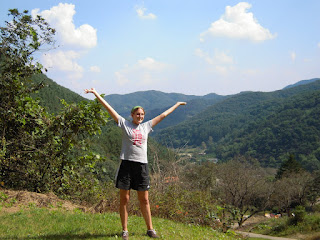
After our pre-hike snack, we found the trail and began our climb. I was so happy to see that this trail was not "Asianized" in that it was not a concrete sidewalk with the occasional handrails. This modernization of nature is a trend that I have seen all over Korea and other parts of Asia. I don't understand it, considering the one thing I enjoy about hiking is the natural aspect of it, an escape from the concrete jungle. Nevertheless, I was very happy to have a natural hike. While we were trekking, we passed a few Korean hikers, equipped with visors, hiking sticks, bright gear, and heavy duty hiking boots. They giggled as they passed us, seeing that we were not in hiking gear with our Tshirts and sneakers.
The hike was very steep at times, making us wish we had those hiking sticks! It reminded me a lot of my hike through northern Thailand: the trail was very gritty in a way, you had to be careful in placing your feet at times. I really enjoyed the trail because it was more of the hiking that I have experienced at home. It was not artificial with concrete and steps.
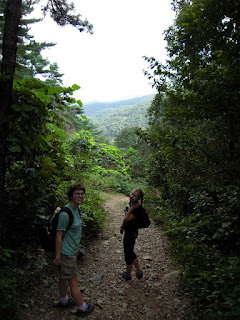
The top was very wooded, so our view was not too ideal. One thing that was quite funny when we were sitting near the top was when we heard a ringtone for a cellphone only then to see a couple hiking up to where we were answering their phone. Even at the top of Gwangdeoksan, you can still get good reception! Oh Korea....
After our hike back down, we made our way back to the city. We then visited a Vegan restaurant for dinner. Birch is Vegan, so she wanted to see this restaurant as it is one of the closest ones to school. It was a buffet, filled with tofu, fake meat, and lots of veggies. I was so happy to see so many fresh vegetables, it was pretty much my entire dinner. I have come to appreciate the prices of vegetables in the USA now that I have lived in Korea. Fruit and Vegetables are very expensive, in part because a lot of it is imported and also because Koreans like to eat organic foods. An apple can cost around $1-$3 depending on the size and where you purchase it. Being at a buffet where vegetables were in abundance, I ate as much as I could. It was interesting being a Vegan for a meal, but I couldn't do it as a lifestyle.
After our Vegan dinner, we made our way back to school. We are hoping to hike again in the next few weeks while we still have warm weather. The weather here has become a bit bipolar at times: it will be warm and sunny one day only to be cool and cloudy the next. Even though it was a balmy 80 during our hike, it got down to the 50's while we were waiting for our subway. I think the jackets will make their debut in the next few weeks.....
We took the subway to Cheonan, ate lunch in town, and then took a bus to the park. Once we reached the park, we walked past several restaurants and shops selling hiking gear before reaching the trail.

I have not hiked in this area of Cheoncheonamdo, so it took a bit of searching to find the right trail. Before we found our trail, we met a group of Korean hikers who were having lunch after climbing to the summit. They invited us to join them for grapes and a chat. It was definitely a test for me in my Korean skills seeing that they could not speak English and Birch and Polina could not understand Korean. For the most part, I caught what they were saying and was able to share a bit about us foreigners. It was an unexpected beginning to our hike, once again I am amazed at the friendliness of Koreans, inviting strangers to join them for lunch and being so kind as we tried to have a conversation.

After our pre-hike snack, we found the trail and began our climb. I was so happy to see that this trail was not "Asianized" in that it was not a concrete sidewalk with the occasional handrails. This modernization of nature is a trend that I have seen all over Korea and other parts of Asia. I don't understand it, considering the one thing I enjoy about hiking is the natural aspect of it, an escape from the concrete jungle. Nevertheless, I was very happy to have a natural hike. While we were trekking, we passed a few Korean hikers, equipped with visors, hiking sticks, bright gear, and heavy duty hiking boots. They giggled as they passed us, seeing that we were not in hiking gear with our Tshirts and sneakers.
The hike was very steep at times, making us wish we had those hiking sticks! It reminded me a lot of my hike through northern Thailand: the trail was very gritty in a way, you had to be careful in placing your feet at times. I really enjoyed the trail because it was more of the hiking that I have experienced at home. It was not artificial with concrete and steps.

The top was very wooded, so our view was not too ideal. One thing that was quite funny when we were sitting near the top was when we heard a ringtone for a cellphone only then to see a couple hiking up to where we were answering their phone. Even at the top of Gwangdeoksan, you can still get good reception! Oh Korea....
After our hike back down, we made our way back to the city. We then visited a Vegan restaurant for dinner. Birch is Vegan, so she wanted to see this restaurant as it is one of the closest ones to school. It was a buffet, filled with tofu, fake meat, and lots of veggies. I was so happy to see so many fresh vegetables, it was pretty much my entire dinner. I have come to appreciate the prices of vegetables in the USA now that I have lived in Korea. Fruit and Vegetables are very expensive, in part because a lot of it is imported and also because Koreans like to eat organic foods. An apple can cost around $1-$3 depending on the size and where you purchase it. Being at a buffet where vegetables were in abundance, I ate as much as I could. It was interesting being a Vegan for a meal, but I couldn't do it as a lifestyle.
After our Vegan dinner, we made our way back to school. We are hoping to hike again in the next few weeks while we still have warm weather. The weather here has become a bit bipolar at times: it will be warm and sunny one day only to be cool and cloudy the next. Even though it was a balmy 80 during our hike, it got down to the 50's while we were waiting for our subway. I think the jackets will make their debut in the next few weeks.....
Subscribe to:
Posts (Atom)